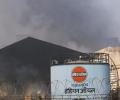
India's largest oil firm IOC will build the nation's first 'green hydrogen' plant at its Mathura refinery, as it aims to prepare for a future catering to the growing demand for both oil and cleaner forms of energy. Indian Oil Corporation (IOC) has drawn a strategic growth path that aims to maintain focus on its core refining and fuel marketing businesses while making bigger inroads into petrochemicals, hydrogen and electric mobility over the next 10 years, its chairman Shrikant Madhav Vaidya said. The company will not set captive power plants at all its future refinery and petrochemical expansion projects and instead use the 250 MW of electricity it produces from renewable sources like solar power, he told PTI in an interview.

'The Weather Channel argues that India faces the gravest challenge: Climate change-induced health vulnerability.' 'This is an issue often neglected, alerts Claude Arpi: "Prolonged summers, unpredictable rains, floods, droughts, and rising sea levels are the harsh realities of climate change in the country. These factors increase the frequency and severity of illnesses, pushing people into poverty, and forcing migration".'

The seasonal temperature would be above normal by more than one degree Celsius over Northwest India.

"This is a momentous occasion," the secretary-general said after the deal was ratified by 72 countries accounting for more than 56 per cent of global greenhouse gas emissions.

The industry may account for just 0.05 per cent of the total volume of single-use plastics in the country. And the product it uses is just one among the 22 - including spoons, forks, plates, knives and trays - that will be banned across the country from July 1 by government order. Yet, it is the plastic straw that is at the centre of public focus as fast-moving consumer goods (FMCG) companies make a last-ditch effort to get the government to extend the deadline.

The world's growing demand for energy is also a big problem.

Since the US, the second biggest emitter of greenhouse gases after China, has shifted in a major way to shale gas, the focus of global environmentalists' ire has fallen on India, which is the third biggest emitter, reports Darryl D'Monte.

The president said he will be signing a number of executive orders over the next several days of the week.

The decision of the Directorate General of Civil Aviation comes at a time when the UN-body International Civil Aviation Organisation is working on global market-based measures to check aviation emissions.

'Respect nature, working with (it) rather than against it.'

So far, major emitters are far from curbs on emissions on a scale outlined by the IPCC.
Observing that climate change has become an urgent concern across the globe, Prime Minister Manmohan singh said on Friday ways and means should be developed to reduce India's carbon footprint as it would be among the nations to be 'most seriously' impacted.

The 2C target was always somewhat arbitrary as a threshold for preventing the worst effects of global warming in the form of rising sea levels and more severe and frequent storms, floods and droughts.

UNICEF estimates that almost 16 million children and their families are in urgent need of life-saving support. Since mid-August, there have been at least 1,288 reported deaths.

Last month, the US and China announced a significant deal setting limits on greenhouse gases.
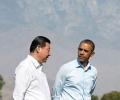
Spread over two days -- Friday and Saturday -- at a picturesque desert resort in Southern California, Obama, 51, and Xi, 59, had several rounds of meetings and a candle-lit dinner spread over nearly eight hours on a range of bilateral, regional and global issues.

The bilateral and Quad summits, in which Prime Minister Modi played a significant role, has sent the right message to China, observes Ambassador T P Sreenivasan.

'Temperature and wind can be predicted more easily than rainfall.' 'Rainfall, as common experience suggests, is very spotty.' 'The last bit of physics required that tells us whether it is going to rain or not is very hard.' Professor Roddam Narasimha, the eminent scientist, explains the monsoon, climate change and global warming, in a fascinating conversation with Shivanand Kanavi.
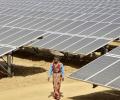
This can happen if the government reaches its goal of 100 giga watts of solar photovoltaic energy and 60 GW of wind energy
'When there is a change in the wind speed or the stress exerted on the surface, it will change the ocean currents.'

Prasanna D Zore/Rediff.com drives the Mahindra Reva to Pune and comes away impressed with the electric car.
'We are not saying we are going to face a drought... We are a doing and performing government. A contingency plan is being prepared,' Science Minister Dr Harsh Vardhan tells Rediff.com
'It is high time that we act instead of just talking about how and why the climate is changing.'
'The choice of chief minister after the win is a pointer to what issues really mattered at the polls.' 'Perhaps, demonetisation was an electoral side issue -- a reflection of the disconnect between commentators in the cities and the realities on the ground,' says Somasekhar Sundaresan.
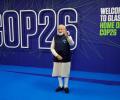
India lost around 38.5 thousand hectares of tropical forest in the last decade. Nearly 14 per cent of the country's tree cover! It is one thing for Modi to announce that India will reach a net-zero level of emissions in 2070. But if it is serious, it needs to start today, points out Ramesh Menon.

The average global temperature between January and October has been 0.68 degrees Celsius higher than the 20th century's average global temperature of 14.1 degree C.

India has remained obsessed with cheap capital and infrastructure spending when instead the central constraint on Indian development remains the abysmal quality of Indians' skills, says Mihir Sharma.

'Please don't celebrate me if you are not going to listen to my voice.'
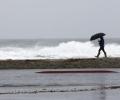
India is actively involved in reducing carbon emissions.

Projects in other developed countries, such as Canada, and even in developing nations like Mozambique and Indonesia are also in limbo

'President Kalam pitched his dreams high. He will be best remembered for that feat.'

Instead of targeting global imbalances per se, the narrative must change to the structure and direction of such asymmetries.

What are the most worrisome aspects of climate change for India? Can they be solved?
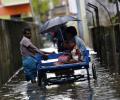
Some of the World Bank's suggestions to hold back the predicted tide of fresh poverty appear to run counter to the economic policies of Narendra Modi's government
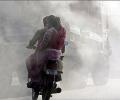
Despite a 187 km, seven-line metro network carrying 2.4 million commuters every day, private vehicles rose 92% over the last 15 years

'Science and technology keep moving ahead and so you can keep making investment.'

COP 21 is about how much carbon space is left and who gets how much of that space

'The past year has yielded extraordinary results in the strategic, commercial, and people-to-people components of the India-United States partnership, US Ambassador to India Richard Rahul Verma tells Aziz Haniffa/Rediff.com in an exclusive interview.

'If a student can't get to school, the school will get to you. Even people with low reading abilities can be taught via videos.' 'Companies and students will be linked to their universities from the beginning and not towards the end of their course.' 'Digitalisation in education will be of enormous impact. Higher education must be closely linked to the demands on the future workforce.'
'If a student can't get to school, the school will get to you. Even people with low reading abilities can be taught via videos.' 'Companies and students will be linked to their universities from the beginning and not towards the end of their course.' 'Digitalisation in education will be of enormous impact. Higher education must be closely linked to the demands on the future workforce.'
